Pearson Edexcel · GCSE · History
Course version: 1HI0 · Version from Sept 2016
C1700–c1900: Crime and punishment in eighteenth- and nineteenth- century…
Full specification wording
Option 10: c1700–c1900: Crime and punishment in eighteenth- and nineteenth- century Britain - 1 Nature and changing definitions of criminal activity: Changing definitions of crime exemplified in the ending of witchcraft prosecutions and treatment of the Tolpuddle Martyrs.
The 18th and 19th centuries saw significant shifts in how crime was defined, reflecting broader societal changes.
Checked against the Pearson Edexcel 1HI0 specification (opens in a new tab) on .
- Point 2 of 2
- 3 key terms
Study notes
From the checked teaching notes for this specification point.
The idea
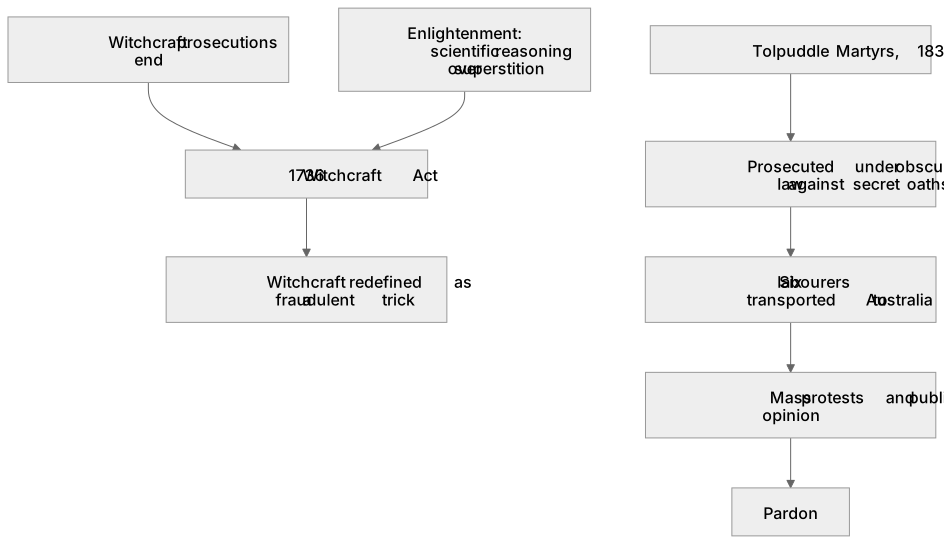
The 18th and 19th centuries saw significant shifts in how crime was defined, reflecting broader societal changes. The ending of witchcraft prosecutions, culminating in the 1736 Witchcraft Act, decriminalised witchcraft, redefining it as a fraudulent trick rather than a supernatural threat. This was driven by the Enlightenment, which promoted scientific reasoning over superstition. Conversely, the treatment of the Tolpuddle Martyrs in 1834 illustrates how authorities manipulated definitions of crime to suppress threats. Six labourers were transported to Australia not for forming a union, which was legal, but under an obscure law against secret oaths. Their eventual pardon highlights the growing influence of public opinion on defining crime.
What earns the marks
- Explain that the 1736 Witchcraft Act ended executions for witchcraft, redefining it as a crime of fraud rather than a supernatural offence.
- Link the decriminalisation of witchcraft to the Enlightenment and the rise of scientific and rational thinking.
- Describe how the Tolpuddle Martyrs were prosecuted in 1834 using an obscure law against secret oaths, rather than for forming a trade union.
- Analyse the role of mass protests and public opinion in securing a pardon for the Tolpuddle Martyrs, demonstrating changing attitudes towards authority.
Common mistakes and how to put them right
Stating that the Tolpuddle Martyrs were arrested for forming a trade union.
Put it right: Forming a union was legal at the time; they were arrested under an old law against administering secret oaths.
Believing people stopped believing in witches immediately after 1736.
Put it right: While the law changed due to educated elite attitudes, belief in witchcraft persisted among the general public for many years.
Confusing the dates and contexts of the two events.
Put it right: The decriminalisation of witchcraft occurred in the early 18th century (1736), while the Tolpuddle Martyrs case happened in the 19th century (1834).
Exam tips
- Use the 1736 Witchcraft Act as a clear example of how changing attitudes and scientific discoveries can lead to the decriminalisation of an activity.
- When discussing the Tolpuddle Martyrs, emphasise the government's fear of the French Revolution and working-class uprisings as the motive for their harsh treatment.
- Contrast the top-down change in witchcraft laws (driven by the elite) with the bottom-up change in the Tolpuddle case (driven by public protest).
Try the lesson
The start of the Option 10: c1700–c1900: Crime and punishment in eighteenth- and nineteenth- century Britain - 1 Nature and changing definitions of criminal activity: Changing definitions of crime exemplified in the ending of witchcraft prosecutions and treatment of the Tolpuddle Martyrs. lesson, made from checked teaching notes for this specification point.
Have a go first
How did the 1736 Witchcraft Act change the legal definition of crime in Britain?
Listen
The 18th and 19th centuries saw significant shifts in how crime was defined, reflecting broader societal changes. The ending of witchcraft prosecutions, culminating in the 1736 Witchcraft Act, decriminalised witchcraft, redefining it as a fraudulent trick rather than a supernatural threat. This was driven by the Enlightenment, which promoted scientific reasoning over superstition. Conversely, the treatment of the Tolpuddle Martyrs in 1834 illustrates how authorities manipulated definitions of crime to suppress threats. Six labourers were transported to Australia not for forming a union, which was legal, but under an obscure law against secret oaths. Their eventual pardon highlights the growing influence of public opinion on defining crime. A strong answer earns marks for these points. Explain that the 1736 Witchcraft Act ended executions for witchcraft, redefining it as a crime of fraud rather than a supernatural offence. Link the decriminalisation of witchcraft to the Enlightenment and the rise of scientific and rational thinking. Describe how the Tolpuddle Martyrs were prosecuted in 1834 using an obscure law against secret oaths, rather than for forming a trade union. Analyse the role of mass protests and public opinion in securing a pardon for the Tolpuddle Martyrs, demonstrating changing attitudes towards authority. A common slip: Stating that the Tolpuddle Martyrs were arrested for forming a trade union. Instead, forming a union was legal at the time; they were arrested under an old law against administering secret oaths. Exam tip: Use the 1736 Witchcraft Act as a clear example of how changing attitudes and scientific discoveries can lead to the decriminalisation of an activity.
See it
Key words
Say what each word means before you turn the card.
Enlightenment
Try answering aloud or in your head before turning the card.
1736 Witchcraft Act
Try answering aloud or in your head before turning the card.
Tolpuddle Martyrs
Try answering aloud or in your head before turning the card.
See every definition
- Enlightenment
- A movement that promoted scientific reasoning over superstition and drove the ending of witchcraft prosecutions.
- 1736 Witchcraft Act
- This law ended executions for witchcraft, redefining it as a crime of fraud rather than a supernatural offence.
- Tolpuddle Martyrs
- Six labourers transported to Australia in 1834 under an obscure law against secret oaths, rather than for forming a trade union, which was legal.
Label the diagram
Some boxes have lost their names. Pick the right name for each number.
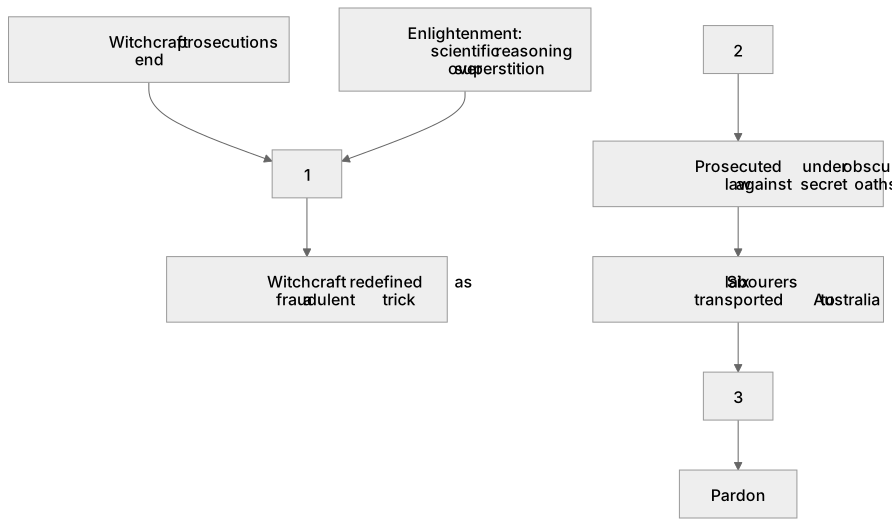
1Box 1
2Box 2
3Box 3
There is more to this lesson
The full lesson goes on to check your understanding and help you earn the marks. Create a free account to carry on, with your progress saved.
A week of Premium from your first lesson · Then the free plan continues · No card, no charge
Test your understanding of Option 10: c1700–c1900: Crime and punishment in eighteenth- and nineteenth- century Britain - 1 Nature and changing definitions of criminal activity: Changing definitions of crime exemplified in the ending of witchcraft prosecutions and treatment of the Tolpuddle Martyrs.
Active recall beats re-reading. Take an instant quiz now to test what you’ve learned and lock it into long-term memory.
A week of Premium from your first lesson · Then the free plan continues · No card, no charge